Symbiosky
Monetizing Credibility, Not Clicks
A Conviction Voting Platform for Sustainable Knowledge Work
Symbiosky addresses a fundamental misalignment in how digital platforms compensate knowledge workers. While ad-driven social media rewards viral content and engagement metrics, researchers, journalists, and educators struggle to monetize credible, high-quality work that serves long-term public good.
Built on Bluesky's AT Protocol with over 40 million users, Symbiosky introduces a credibility-first marketplace that uses conviction voting to route funding toward trustworthy contributors. By requiring voters to lock tokens proportional to their confidence level, the system naturally filters short-term manipulation while amplifying sustained, truthful conviction.
Key innovations include:
- Conviction voting mechanism that rewards long-term commitment over speculative behavior
- Merit-based rewards distributed monthly based on community scoring (1-10 scale)
- Decay-resistant reputation that protects active participants while discouraging inactive token hoarding
- Threshold-based funding ensuring only well-supported proposals receive rewards
- Open protocol integration leveraging Bluesky's decentralized infrastructure
Problem Statement
The Attention Economy's Broken Incentives
Modern social platforms optimize for engagement metrics that maximize advertising revenue. This creates perverse incentives where:
- Viral misinformation spreads faster than careful fact-checking
- Clickbait headlines outcompete nuanced analysis
- Researchers and educators lack sustainable funding mechanisms
- Quality journalism struggles to compete with sensationalism
- Long-term value creation is undercompensated
The root cause is simple: platforms monetize attention, not credibility. A researcher publishing peer-reviewed findings receives no more financial support than a conspiracy theorist generating viral rage clicks.
The Credibility Gap
Knowledge workers face a credibility-monetization gap. While their work may have high epistemic value and long-term social impact, current platforms offer no mechanism to capture this value. Traditional solutions like paywalls, subscriptions, and grants each have limitations:
- Paywalls restrict access and reduce impact
- Subscriptions require constant content production
- Grants involve lengthy applications and institutional gatekeeping
- Donations are unpredictable and favor emotional appeals
What's needed is a system that allows communities to directly fund credible work based on sustained conviction rather than momentary attention.
Solution: The Symbiosky Platform
Overview
Symbiosky is a credibility marketplace built on three core principles:
- Conviction over clicks: Voting power scales with token lock duration
- Merit over virality: Rewards based on quality scores, not engagement
- Community over algorithms: Decentralized governance via token holders
The platform enables any user to submit proposals (content, research, journalism, educational materials) and receive monthly funding based on how the community scores their credibility and value.
The Bluesky Advantage
Symbiosky leverages Bluesky's AT Protocol, which provides:
- 40+ million user base for immediate network effects
- Decentralized architecture ensuring platform resilience
- Composable feeds allowing algorithmic choice
- Open protocol enabling third-party integrations
- Credible exit preventing platform lock-in
This infrastructure allows Symbiosky to focus on governance and incentive design rather than reinventing social networking.
Website Links
Symbiosky Website
Currently on Testnet
Bluesky link
https://bsky.app/profile/did:plc:il4tjezsxcinsljjti457ptz
Whitepaper
https://gitlab.com/blockchain-projects-ecosymra/symbiosky-whitpaper
Arbitrum Docs
https://docs.arbitrum.io/learn-more/faq
How to Use a Crypto Wallet (Quick Guide)
1. Choose a Wallet
You can use any trusted non-custodial wallet. Two simple options:
Option 1: Brave Browser Wallet (Built-in)
- Install the Brave Browser.
- Go to the official website: https://brave.com/
- Open Brave → Click the Wallet icon in the toolbar.
- Follow the steps to create a new wallet.
Option 2: MetaMask Wallet
- Go to the official website: https://metamask.io/
- Install the browser extension (Chrome, Firefox, Brave, etc.).
- Click Create a Wallet and follow the setup process.
⚠️ Always download wallets only from official websites.
2. Create Your Wallet
When you create a wallet:
- Set a strong password.
- You will receive a Seed Phrase (12–24 words).
This seed phrase is the master key to your wallet.
3. Keep Your Seed Phrase Safe (Very Important)
- Write it down on paper.
- Store it in a safe place.
- Never share it with anyone.
- Never store it in email, screenshots, or cloud notes.
👉 Anyone with your seed phrase can steal all your funds.
4. Basic Usage
With your wallet you can:
- Receive crypto → Copy your wallet address.
- Send crypto → Enter recipient address and confirm.
- Connect to apps → Click “Connect Wallet” on websites.
Always double-check:
- Website URL
- Transaction details before confirming
5. Security Best Practices
For better safety:
- Use one wallet per app/project.
- This limits risk if one site is malicious.
- Avoid clicking random crypto links.
- Never approve suspicious transactions.
- Disconnect wallet from unknown sites.
This protects you from:
- Phishing websites
- Fake dApps
- Permission abuse
6. Important Safety Rule
❌ No legitimate app will EVER ask for your seed phrase. If someone asks → it is a scam.
Testnet Tokens Guide (For Symbiosky Testing)
To use Symbiosky Testnet, you need two things:
- Sepolia ETH → for gas fees
- SYSKY Testnet Tokens → to use the platform
Follow the steps below.
Step 1: Get Sepolia ETH (Testnet ETH)
Sepolia ETH is free testnet currency used only for testing.
How to Get It
-
Open the Sepolia Faucet: https://sepolia-faucet.pk910.de/
-
Enter your wallet address.
-
Request test ETH through mining.
-
Wait a few seconds or minutes — your wallet will receive Sepolia ETH.
✅ This ETH will be on the Ethereum Sepolia Network.
Step 2: Bridge ETH to Arbitrum Sepolia
Symbiosky testnet runs on Arbitrum Sepolia, so you must bridge your ETH.
Bridge Steps
-
Open the official Arbitrum Bridge: https://portal.arbitrum.io/bridge?destinationChain=arbitrum-sepolia&sanitized=true&sourceChain=sepolia
-
Connect your wallet.
-
Select:
- Source: Sepolia
- Destination: Arbitrum Sepolia
-
Enter the amount of ETH.
-
Confirm the transaction.
After bridging, your ETH will appear on Arbitrum Sepolia and can be used for gas fees.
Step 3: Get SYSKY Testnet Tokens
SYSKY testnet tokens are distributed manually.
How to Request
- Open Bluesky.
- DM the official Symbiosky account.
- Send your wallet address.
- Request SYSKY Testnet Tokens.
Final Checklist Before Testing
Make sure your wallet has:
✅ Arbitrum Sepolia network selected
✅ ETH on Arbitrum Sepolia (for gas)
✅ SYSKY Testnet tokens
Important Notes
- Testnet tokens have no real value.
- They are only used for testing.
- Always keep some ETH for gas before interacting with the app.
How to Add a Symbiosky Testnet Token (Asset) in Brave Wallet 🦁
✅ Step-by-Step Tutorial
1. Open Brave Wallet
- Click the wallet icon in the Brave browser toolbar OR
- Go to:
brave://wallet
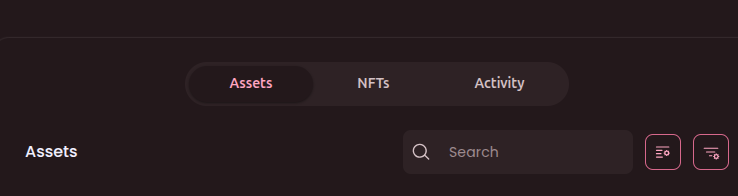
2. Go to the Assets Tab
- Inside the wallet, open the “Assets” section.
3. Click “Add Asset”
- Look for the ➕ Add Asset button.
- Click it.
4. Select “Add Custom Asset”
- Choose “Add Custom Asset” (not from the default token list).
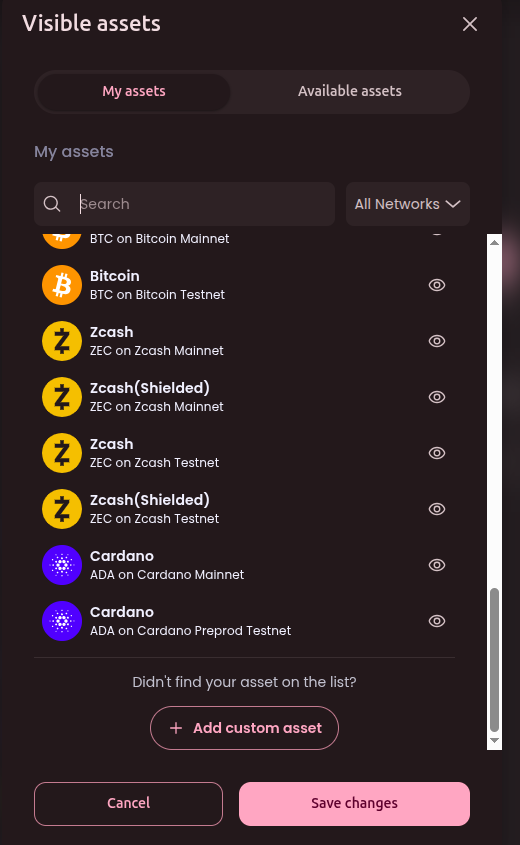
5. Enter Token Details
You will need to fill in:
- Network → Select correct network -> Arbitrum Sepolia
- Contract Address → Paste the token contract address
0x072A24E0C25a5D8c7F3f62146eF1900b5033e42d
- Token Name → SYSKY Token
- Token Symbol → SYSKY
- Decimals → 18
👉 Tip: Once you paste the contract address, Brave often auto-fills the rest.
6. Click “Add”
- Confirm by clicking Add Asset.
- Your token will now appear in your wallet.
⚠️ Important Tips
-
Always copy the contract address from trusted sources:
- Official project website
- Verified block explorers (arbiscan, Etherscan)
-
Wrong contract = fake token display.
Tokens Needed to Use Symbiosky
Note: The mainnet has not been launched yet.
To use Symbiosky, you will need two types of tokens in your wallet:
1. Symbiosky Tokens (SYSKY)
SYSKY is the main utility token of the Symbiosky platform.
You need SYSKY to:
- Access platform features
- Participate in the ecosystem
- Make transactions within Symbiosky
Make sure your wallet holds enough SYSKY before using the app.
2. ETH for Gas Fees
Symbiosky is hosted on the Arbitrum Network, which is a Layer-2 network built on Ethereum.
Because Arbitrum uses Ethereum’s infrastructure:
👉 ETH is required to pay transaction (gas) fees.
Every action such as:
- Sending tokens
- Interacting with smart contracts
- Using Symbiosky features
will require a small amount of ETH.
Why Do I Need ETH on Arbitrum?
ETH is the native currency of Arbitrum.
It is used to:
- Pay gas fees for all transactions
- Secure and power the network
- Process smart contract interactions
Without ETH, your transactions cannot be processed.
How to Get ETH on Arbitrum
You cannot directly use Ethereum Mainnet ETH on Arbitrum — you must bridge it.
Steps:
- Get ETH on Ethereum Mainnet (from an exchange or wallet).
- Go to the official Arbitrum Bridge: https://portal.arbitrum.io/bridge
- Connect your wallet.
- Transfer ETH from Ethereum → Arbitrum.
- After bridging, your ETH will appear on the Arbitrum network.
You can also bridge other supported tokens if needed.
Quick Checklist Before Using Symbiosky
Make sure your wallet has:
✅ SYSKY tokens
✅ ETH on Arbitrum for gas fees
✅ Arbitrum network selected in your wallet
Important Tip
Always keep a small amount of ETH in your wallet.
If you run out of ETH:
- You won’t be able to send SYSKY
- You can’t interact with the platform
Proposal Lifecycle
1. Author stakes reputation tokens
   ↓
2. Proposal enters voting period
   ↓
3. Community votes with convictions
   ↓
4. Voting period ends
   ↓
5. Score is calculated (if thresholds met)
   ↓
6. Score expiration timer starts
   ↓
7. Reward can be released (if score ≥ 5)
   ↓
8. Author can reclaim stake (if score ≥ 5)
Conviction Lifecycle
1. User creates conviction with level & stake
   ↓
2. Conviction can vote on proposals (up to limit)
   ↓
3. Lock duration begins
   ↓
4. After lock expires, stake can be released
   ↓
5. Conviction becomes inactive
How to Create a Proposal (Earn SYSKY Incentives)
You can create a proposal in Symbiosky to earn SYSKY token incentives based on the work you do for the ecosystem.
Follow the steps below.
Navigate to Dashboard → Proposals → Create Proposal.
Step 1: Post Your Signature in the Thread
To prevent impersonation, you must post a cryptographic signature in your Bluesky thread.
This proves that:
- The wallet submitting the proposal truly belongs to you
- No one can fake your identity
Signature Format
Your signature must follow this format:
did:plc:il4tjezsxcinsljjti457ptz

🔐 Signed by: 0x13db02Ca2f09DC38002dA2f20775707F771dde86
📝 Signature: 0xd0a4a62c87f7c6989944d4e8e1decc94ae1ed16303ee71e4ecc2fc565d8ab0482c03e5387640f432719cb43ad873f674ea47f14be095a5ac6de43960d18738351c
This signature:
- Links your Bluesky DID to your wallet address
- Prevents impersonation attacks
- Ensures proposal authenticity
Step 2: Prepare Your Bluesky Thread
Before submitting a proposal, you must create a public Bluesky thread that explains your work.
Your thread should include:
- What you are building or contributing
- Clear description of the work
- Updates or progress (optional but recommended)
You will need to submit the link to this thread when creating the proposal.
Step 3: Stake 1 SYSKY Token
To submit a proposal, you must stake 1 SYSKY token.
This stake helps:
- Prevent spam proposals
- Ensure serious submissions
Step 4: Submit the Proposal
When creating your proposal, you will need to provide:
- Bluesky thread link
- Your signature (already posted in the thread)
- Required stake (1 SYSKY token)
Once submitted, your proposal will go through evaluation. You will also receive a proposal ID.
Step 5: Proposal Scoring & Rewards
Proposals are scored between 0–10.
If Accepted (Score 5–10)
You will receive:
- Your 1 SYSKY stake returned
- Additional SYSKY incentives based on your score
Higher scores → Higher rewards.
If Rejected (Score Below 5)
- Your stake may not be returned.
- You can improve your work and submit again.
Important Tips
- Always post your signature in the Bluesky thread before submitting.
- Make sure your work description is clear and detailed.
- Keep updating your thread to improve your evaluation score.
How to Create a Conviction
Conviction allows you to lock your SYSKY tokens to gain stronger voting power when voting on proposals.
The longer you lock your tokens, the more influence your vote will have.
Step 1: Navigate to Conviction Page
Go to:
Dashboard → Create Conviction
This is where you can choose how much to stake and how long to lock your tokens.
Step 2: Understand How Conviction Works
Creating a conviction means you are committing your tokens for a period of time.
Key Concepts
Time-Locked Stake = Commitment Cost When you create a conviction, your tokens are locked and cannot be used elsewhere during the lock period.
Voting Power Increases with Duration The longer you lock your tokens, the higher your voting power. This follows a conviction curve, meaning longer commitments give disproportionately stronger influence.
Opportunity Cost Since your tokens are locked, you cannot:
- Transfer them
- Use them in other proposals
- Trade or stake them elsewhere
Step 3: Choose Your Conviction Level
There are 10 conviction levels, each with different lock durations.
Higher levels:
- Lock tokens for longer
- Provide more voting power
Lower levels:
- Shorter lock time
- Less voting influence
Step 4: Voting with Conviction
Once created:
- Each conviction gives you 10 vote for voting different proposals.
- You cannot vote twice on the same proposal using the same conviction.
This ensures fair participation while allowing committed users to have stronger influence.
Step 5: Unlocking Your Tokens
After the conviction period ends you can unlock your token.
Higher conviction levels → Longer unlock periods.
Important Tips
- Choose lock duration carefully — you cannot withdraw early.
- Higher conviction increases your impact on governance decisions.
- Diversifying across conviction levels can help manage liquidity.
How to Vote on a Proposal
Voting allows you to evaluate proposals and help decide how SYSKY incentives are distributed.
Step 1: Navigate to Voting Page
Go to:
Dashboard → Vote on Proposal
This is where you can submit your vote.
Step 2: What You Need Before Voting
To vote, you must have:
- A Proposal ID (the proposal you want to vote on)
- A Conviction ID (your locked stake used for voting)
- An active conviction (not expired)
- The proposal must still be within its active voting period
You cannot vote once the voting window has closed.
Step 3: Submit Your Vote
When voting, you will:
- Enter the Proposal ID
- Select your Conviction ID
- Choose a score between 0–10
- Submit your vote
Your voting power depends on your conviction level (lock duration).
Step 4: Voting Rules
- You can vote only once per proposal using a conviction.
- You cannot use the same conviction to vote twice on the same proposal.
- Higher conviction = stronger voting weight.
Step 5: Vote Fairly and Responsibly
Always evaluate proposals carefully before voting.
Consider whether:
- The work is genuine and clearly documented
- The contribution benefits the ecosystem
- The effort matches the requested incentives
- Evidence and progress are verifiable
Step 6: Types of Contributions to Evaluate
Proposals may fall into different categories, such as:
- Journalism — reporting, awareness, public communication
- Research & Academia — studies, analysis, technical papers
- Civic Issues — governance, public engagement, community work
- Education — tutorials, guides, knowledge sharing
- Open Source — code contributions, tools, infrastructure
Each category may require different evaluation standards.
Remember that if the conviction-weighted mean score is between 5 and 10, the proposal will receive incentives.
Important Tips
- Vote honestly and based on quality.
- Avoid bias or personal influence.
- Responsible voting strengthens the ecosystem.
SymbioSky Token Economics: Funding Credibility Through Conviction
SymbioSky is designed to solve one of the biggest problems of the digital economy: how to sustainably fund meaningful work without relying on ads, speculation, or short-term hype.
Its token economics are structured to reward long-term contribution, credibility, and community trust, rather than early insiders or opportunistic actors.
1. Token Supply Structure
The total token supply for the Initial Coin Offering (ICO) will be allocated as follows:
📊 Allocation Breakdown
Total Supply: 10,000,000 Tokens
-
10% — Targeted Airdrop
- Distributed to early verified contributors.
- Designed to seed the ecosystem with credible participants.
-
70% — Public Purchase Allocation
- Available through targeted token purchase.
- Ensures broad but controlled participation.
-
20% — Developers & Marketing
- Supports long-term protocol development.
- Funds ecosystem growth, outreach, and infrastructure.
This structure ensures that most tokens enter circulation through active participation, not passive speculation.
2. Admin-Signature Based Distribution
SymbioSky introduces a key innovation: Admin-signature enabled token distribution.
This mechanism allows:
- Targeted airdrops to verified contributors
- Controlled token purchase eligibility
- Protection against bot farms and speculative manipulation
Unlike open ICOs that often attract short-term traders, this approach ensures that:
Only serious contributors can participate in the initial token distribution.
The goal is simple: Prevent bad actors from entering early and distorting governance incentives.
3. Who Receives Initial Tokens?
Initial token offerings will prioritize contributors who create real societal value, including:
- Journalists
- Researchers and academics
- Students
- Civic organizations
- Open-source maintainers
- Writers and artists
Tokens will not be distributed all at once. Instead, they will be released gradually over many years based on:
- Verified contributions
- Community support
- Sustained participation
This ensures a long-term alignment between contributors and the ecosystem.
4. Utility: Conviction Voting for Funding Decisions
SymbioSky tokens are not merely speculative assets. They serve as governance and funding instruments through conviction voting.
Users can stake tokens to support initiatives they believe in. The longer and stronger the conviction, the more funding flows to that project.
This transforms funding from:
❌ Popularity contests
❌ Click-driven revenue models
❌ Centralized grant decisions
into:
✅ Community trust signals
✅ Long-term support mechanisms
✅ Credibility-based funding
5. Long-Term Vision
SymbioSky’s token economics aim to create a new funding paradigm:
- Credibility over hype
- Contribution over speculation
- Long-term support over short-term gains
By combining targeted distribution with conviction-based funding, SymbioSky builds an ecosystem where:
Value flows to those who create meaningful, trusted, and socially beneficial work.
The Case for Randomized Jury Selection in Symbiosky
Date: 17-02-2026
Why Conviction Should Earn Your Ticket, Not Guarantee Your Seat
The current Symbiosky model is built on a clean and powerful premise: conviction voting routes funding toward the most credible contributors. Lock tokens, signal confidence, let the mechanism sort truth from noise. It works because skin in the game is a better filter than passive opinion. But conviction alone has a structural ceiling — and crossing that ceiling may require borrowing one of the oldest and most resilient ideas in democratic governance.
The future milestone is this: even participants who demonstrate strong conviction should face a randomized probability of being selected as a juror — roughly a one-in-three or one-in-five chance. Conviction earns you a seat in the lottery. The lottery decides who actually judges.
The Conviction Reset Loophole
The contract's conviction lifecycle has a natural rhythm: create a conviction, lock tokens for a duration scaled by level, vote during the allowed window, then release the stake once the lock expires and begin again. This cycle is rational and well-designed. It demands real commitment at every stage.
But it also creates an optimization game. A sophisticated participant learns to time their releases and re-stakes carefully — always maintaining active conviction during high-stakes proposal windows, releasing during quiet periods to free liquidity, re-entering before the next important vote. Nothing in this behavior violates any rule. It is simply playing well.
The problem is that playing well requires resources, attention, and experience. Participants who have been in the system longer understand the cycle better. Those with more tokens can afford to maintain larger conviction positions continuously without worrying about the liquidity cost of locking. Over time, the gap between sophisticated and unsophisticated participants widens — not because the system is rigged, but because it is predictable, and predictable systems reward the people who study them most closely.
Randomization disrupts this without punishing sophistication. The expert player who times their conviction perfectly still qualifies for the jury pool. They are simply no longer guaranteed to sit on every jury their tokens make them eligible for. Their advantage becomes probabilistic rather than deterministic. They may sit on one jury in three, or one in five. Across many decisions and many participants, the outcomes reflect the eligible community rather than its most optimized subset.
Conviction Was Already Pointing in This Direction
Based upon the contract's design choices, it becomes clear that the we were already thinking about concentration risk — they just stopped one layer short of randomization.
The minimum vote count requirement, hardcoded at launch to require at least four distinct participants, exists precisely because a single high-conviction actor should not be able to unilaterally validate a proposal. The logic is sound: distributed judgment is more trustworthy than concentrated judgment, even if the concentrated actor is genuinely credible. The threshold is a structural guarantee that at least four voices contribute to every score.
The minimum total conviction threshold works alongside this, requiring that the aggregate weight of participation crosses a meaningful baseline before a score counts. Again, the instinct is correct: a handful of tiny, low-stakes votes should not determine the fate of a proposal any more than a single enormous one.
Both of these mechanisms are anti-concentration measures. They say, in effect, that the system does not trust any single participant or small cluster of participants to produce a valid outcome alone. Randomized jury selection is simply the logical completion of that reasoning. It does not add a new principle — it enforces the existing one at the selection stage rather than only at the aggregation stage.
Weight Calculation and Why It Creates a Rich-Get-Richer Dynamic
The voting weight in this system is determined by multiplying conviction level by staked amount. A participant who stakes more and declares a higher level casts a proportionally heavier vote. This is intentional and fair as a signal of commitment — someone willing to lock more tokens at a higher level for longer is demonstrating stronger belief, and their signal should reflect that.
But consider the compounding effect across many proposals. A participant with a level-ten conviction and a large stake does not just cast a heavy vote on one proposal — they cast a heavy vote on every proposal within their vote budget. Their influence across the entire proposal landscape is proportional to their resources, not their judgment. A participant with a level-three conviction and a modest stake might have equally sound judgment about a specific proposal but will be systematically outweighed regardless.
Randomized selection addresses this asymmetry at the composition level rather than the weight level. Rather than limiting how heavy any single vote can be — which would require rewriting the core incentive mechanism — it limits how reliably any participant can show up to cast that heavy vote. The weight system remains intact. The high-conviction participant still votes with full weight when selected. But whether they are selected for any particular jury is a matter of chance, not accumulation. Their resources buy more lottery tickets. They do not buy a permanent seat.
Coordinated Blocs and the Limits of Anti-Double-Vote Protection
The contract prevents any single conviction from voting on the same proposal twice, and it caps the total number of proposals any single conviction can touch across its lifetime. These are important protections against the most obvious forms of vote manipulation.
What they do not protect against is coordinated participation by multiple independent convictions controlled by aligned interests. A group of participants who share goals but hold separate convictions can each vote independently, each within their personal vote budgets, each triggering no anti-double-vote checks — and collectively dominate the scoring of proposals that matter to them while ignoring proposals that do not.
This is not a flaw in the anti-double-vote logic. That logic is correctly designed to prevent individual manipulation. The coordination attack operates at a level above the individual — it is a social exploit rather than a contract exploit. And it is the type of attack that grows more feasible, not less, as the system matures and high-stakes participants have more to gain from coordinating.
Randomization is the most effective defense against coordination attacks in governance systems, and it does not require identifying or penalizing the coordinators. If a coordinated bloc cannot guarantee which of its members will be selected for any given jury, coordinating in advance becomes dramatically harder. The bloc might control thirty percent of the eligible pool and still find that their members collectively hold a minority on any particular jury. Across many proposals, their aggregate influence remains proportional to their participation — but they cannot concentrate it on the decisions that matter most to them.
What Randomization Preserves
It is worth being equally clear about what randomization does not change, because the conviction mechanism's strengths are real and should not be dissolved in the name of fairness.
The cost of entry remains real. Locking tokens at a declared level for a scaled duration is still the price of eligibility. Casual or speculative participants who are unwilling to make that commitment remain excluded. The system continues to filter for genuine stakeholders.
The signal quality of individual votes is unchanged. A level-eight conviction holder casting a vote on a proposal still contributes a weighted signal proportional to their stake and level. Randomization determines whether they vote, not how much their vote counts when they do.
The decay mechanism continues to enforce ongoing engagement. Participants who go inactive still face erosion of their unprotected balance. The protection afforded to active participants who maintain conviction stakes still applies. Randomization does not exempt anyone from these dynamics.
And critically, higher conviction still produces more lottery entries over time. A level-ten participant with a long lock duration remains eligible across more proposal cycles than a level-two participant. The probability advantage of deeper commitment is real — it is simply no longer absolute.
Conviction as Qualification, Selection as Democracy
The most precise way to understand the proposal is as a separation of two functions that the current system handles with a single mechanism.
Conviction voting currently handles both qualification — determining who is serious enough to participate — and selection — determining who actually does participate in any given decision. These are different tasks with different optimal solutions. Conviction is the right tool for qualification: it requires real commitment, punishes insincerity, and scales with genuine belief. Randomness is the right tool for selection: it is immune to resource advantages, resistant to coordination, and naturally representative of the eligible pool.
Splitting these functions does not make either one weaker. It makes each one do the job it is actually suited for. Conviction earns the right to be in the draw. The draw decides who sits in judgment. What emerges is a system that is simultaneously meritocratic at the entry stage and democratic at the selection stage — rigorous and open, exclusive and fair.
This article proposes a future governance milestone for Symbiosky. The conviction voting system described is the current operational foundation. Randomized jury selection is a proposed evolution subject to community deliberation and protocol development.
General Benefits of Randomization
Randomization is one of the oldest and most reliable tools for eliminating bias that neither the designer nor the participant can fully anticipate. When selection is left to human judgment — however well-intentioned — it tends to drift toward the familiar, the credentialed, and the already-powerful. People select people who look like them, think like them, or have already demonstrated influence within the same system. Randomization cuts through this drift entirely. It does not care about reputation, tenure, or social proximity. A draw treats a newcomer and a veteran as equally likely candidates, which means the resulting group reflects the actual distribution of the eligible population rather than the preferences of whoever controls the selection process.
Beyond fairness, randomization provides something that no merit-based system can fully replicate: resistance to gaming. Any system with legible selection criteria can be optimized against. If credibility scores determine selection, participants learn to maximize credibility scores. If activity metrics determine selection, participants learn to game activity metrics. The criteria themselves become the target, and the signal they were meant to carry gets hollowed out over time. Randomization short-circuits this dynamic because there is nothing to optimize against. A participant can do everything right — stake tokens, vote consistently, build genuine reputation — and still face a one-in-five chance of being drawn. The randomness is not a bug in the incentive system; it is a deliberate immunity to the kind of strategic optimization that corrupts legible criteria over time.
Finally, randomization produces legitimacy that selection-by-merit struggles to achieve on its own. A verdict or outcome produced by a randomly drawn group carries a particular moral authority: no one chose these people, no one arranged for a favorable composition, and no interest group can claim the panel was stacked in their direction. This is why citizen juries selected by lot have been trusted to decide consequential matters for centuries, in cultures with vastly different notions of expertise and authority. The randomness itself is the credential. It signals that the process was fair not because the participants were optimal, but because no one got to decide who the participants were — and that assurance, more than any qualification threshold, is what makes the outcome worth accepting.
Trust doesn’t scale. Coordination does.
Date: 15-02-2026
Communities fail without coordination.
Trust doesn’t scale. Coordination does.
That’s why we build protocols.
Trust doesn’t scale
Trust is human, relational, and expensive.
- Trust works well in small groups: families, villages, close teams.
- It depends on:
- repeated interactions
- shared norms
- reputation
- social punishment
All of that breaks down with size.
Why?
- You can’t know millions of people.
- You can’t verify intentions at scale.
- Bad actors become statistically inevitable.
- Enforcement becomes informal → unreliable.
That’s why:
- Villages run on trust
- Nations don’t
Large systems that pretend to run on trust end up relying on:
- elites,
- gatekeepers,
- or coercion.
Coordination scale
Coordination is structural, not personal.
Coordination replaces who you trust with how the system behaves.
Examples:
-
Markets coordinate via prices
-
Traffic coordinates via signals
-
Internet coordinates via protocols
-
Blockchains coordinate via consensus rules
You don’t trust each participant. You trust the rules + incentives + verification.
This is why:
- Open-source beats benevolence
- Protocols beat promises
- Systems beat heroes
Symbiosky is about scaling coordination
Symbiosky is built on this fundamental insight: the future of knowledge work is not about scaling trust — it is about scaling coordination. The platform recognizes that credible information cannot rely on personal reputation alone in a world of billions of participants. Instead, it creates a structured mechanism where communities coordinate funding decisions using conviction voting.
Rather than asking “Who do you trust?”, the system asks “How strongly are you willing to commit to your belief?” This shift transforms credibility from a social perception into an economically verifiable signal.
In today’s attention economy, platforms monetize engagement rather than truth. Viral content spreads not because it is credible, but because it captures attention. As a result, independent researchers, journalists, educators, civil societies, and advocacy groups struggle to sustain themselves financially, even when their work provides long-term public value. This is not a failure of individuals — it is a failure of coordination. Society lacks mechanisms to collectively fund credibility at scale.
Symbiosky addresses this coordination gap. By requiring participants to lock tokens proportional to their conviction, the platform creates incentives for long-term commitment rather than short-term manipulation. Participants do not need to trust each voter’s intentions; the system itself filters behavior through economic incentives. Short-term speculators cannot sustain influence because they are unwilling to bear the cost of long-term commitment. Over time, consistent, truthful participants naturally accumulate influence.
This is why protocols matter. Protocols transform social problems into coordination problems that can be solved systematically. They replace promises with rules, personalities with processes, and centralized control with decentralized participation. Symbiosky applies this principle to one of the most critical challenges of the digital age: funding credible knowledge.
At its core, Symbiosky is not just a platform — it is coordination infrastructure for the credibility economy. It enables communities to collectively decide what deserves support, without relying on centralized gatekeepers or fragile social trust. In a world where information is abundant but credibility is scarce, the ability to coordinate at scale will determine which ideas survive and which fade.
The future of knowledge is not about who we trust. It is about how well we coordinate.
Decentralization · Algorithms · Coordination
How College Students Can Turn Learning into Credibility — and Income
Date: 16-02-2026
Monetizing Credibility, Not Clicks
College students today spend a significant portion of their time on social media, but much of that energy gets diverted into low-value activities. Algorithms on mainstream platforms are designed to maximize engagement, not learning or creativity. As a result, they tend to amplify sensational reels, viral drama, outrage content, and shallow trends rather than thoughtful ideas or meaningful work. Over time, this creates a cycle where students consume and produce content that attracts quick attention instead of building real skills, knowledge, or long-term credibility.
This algorithmic environment also fuels misinformation and noise. Content that triggers strong emotions spreads faster than careful explanations or nuanced discussions. Students who might otherwise share educational insights, research findings, or creative projects often feel discouraged because such contributions receive far less visibility compared to entertainment or controversy. The outcome is a distorted digital culture where serious effort is undervalued, while distraction becomes the default.
Platforms like Bluesky and its open AT Protocol offer a pathway to change this dynamic. By enabling systems like Symbiosky—where visibility and rewards are tied to credibility, community evaluation, and long-term conviction rather than raw engagement metrics—students can be incentivized to share meaningful work. Instead of chasing algorithmic virality, they can focus on contributing knowledge, solving problems, and building reputations based on genuine value to society.
Student Zone in Symbiosky
College is one of the most productive learning phases of life. Every day, students attend lectures, build projects, solve problems, debate ideas, and participate in social activities that generate real knowledge and real-world impact.
Yet today, almost none of this learning is monetized.
Students either:
- Keep notes private
- Post casually on social media without value capture
- Build projects that remain unseen
- Do community work without long-term recognition
This is exactly the gap Symbiosky aims to solve.
Built on Bluesky’s open AT Protocol, Symbiosky allows students to convert learning into credibility — and credibility into sustainable income through conviction voting.
Instead of chasing likes, students can earn by demonstrating real value to society.
Why Students Are Perfect for Symbiosky
Students naturally produce the kind of work Symbiosky rewards:
✅ Learning-driven
✅ Public-good oriented
✅ Long-term value creation
✅ Knowledge sharing
✅ Community participation
Unlike influencer content, student contributions are often:
- Educational
- Practical
- Honest
- Experiment-driven
- Improvement-focused
This makes students ideal contributors in a credibility-first economy.
The Simple Idea
Every student can follow a simple loop:
Learn → Share → Get Rated → Earn
- Learn something in class or through projects
- Share it publicly on Bluesky
- Community rates your contribution
- Conviction voting routes funding to you
Over time, your reputation grows — and so does your income potential.
What Can Students Upload on Symbiosky?
Here are practical examples.
1. Class Learning Summaries
Students can upload:
- Daily lecture notes
- Simple explainers of difficult concepts
- Visual mind maps
- Real-world applications of theory
Example Posts
- “Explaining blockchain consensus in simple language”
- “How supply and demand actually works in local markets”
- “Understanding AI bias with real examples”
This helps:
- Other students learn faster
- Builds your credibility as a knowledge sharer
2. Explainer Videos
Short educational videos are extremely valuable.
Students can create:
- 5-minute concept explainers
- Animated diagrams
- Step-by-step tutorials
- Lab experiment demonstrations
Example Topics
- How a solar panel works
- What is conviction voting
- How to solve calculus problems
- How neural networks learn
High-quality explainers often receive strong conviction support.
3. Project Showcases
Instead of letting projects die after submission, students can publish them.
Examples:
- Engineering prototypes
- Software applications
- Research reports
- Design portfolios
- Economic simulations
Example Uploads
- “Built a low-cost water purifier for rural areas”
- “Created a decentralized voting prototype”
- “AI model for crop disease detection”
Projects with real-world utility often receive sustained funding.
4. Community Service Work
Symbiosky values social impact — not just technical work.
Students can upload:
- Teaching underprivileged children
- Environmental cleanup drives
- Rural development projects
- Public awareness campaigns
Example Posts
- “Organized plastic cleanup drive — results and learnings”
- “Teaching digital literacy to village elders”
- “Community kitchen logistics optimization”
These contributions demonstrate social credibility, which conviction voters strongly reward.
5. Research Simplification
Students can translate complex knowledge into accessible formats.
Examples:
- Simplifying academic papers
- Breaking down policy documents
- Explaining scientific discoveries
Example Content
- “Explaining climate change models in simple terms”
- “What India’s budget means for students”
- “Understanding CRISPR gene editing”
This creates massive public value.
6. Skill Tutorials
Students can teach what they know.
Examples:
- Programming tutorials
- Language learning guides
- Exam preparation tips
- Career navigation advice
Example Uploads
- “How to learn Rust in 30 days”
- “How to prepare for GATE exams”
- “Beginner guide to public speaking”
Teaching others is one of the strongest credibility signals.
7. Problem-Solving Case Studies
Students can document real-world problem solving.
Examples:
- Campus waste management solution
- Improving public transport routing
- Optimizing college resource usage
These demonstrate practical thinking.
8. Field Learning Experiences
Students often gain knowledge outside classrooms.
Examples:
- Industry internships
- Village surveys
- NGO work
- Startup experiences
Documenting these insights is highly valuable.
9. Collaborative Work
Group contributions also matter.
Students can upload:
- Team projects
- Study group insights
- Debate outcomes
- Joint research findings
Symbiosky supports shared credibility.
10. Long-Term Learning Journeys
Students can document progress over time.
Examples:
- “My 6-month journey learning AI”
- “Building a startup from scratch”
- “From beginner to open-source contributor”
Consistency builds strong conviction support.
Why Students Should Start Early
Students who begin early gain major advantages:
1. Build Credibility Before Graduation
Instead of starting from zero, students graduate with:
- Public reputation
- Verified contributions
- Community trust
- Funding track record
2. Earn While Learning
Symbiosky allows students to:
- Fund education costs
- Support research activities
- Reduce financial dependence
3. Create a Public Knowledge Portfolio
Better than resumes, students build:
- Living proof of competence
- Transparent skill records
- Community-verified work
4. Contribute to Public Good
Students become:
- Knowledge producers
- Community educators
- Social problem solvers
The Bigger Vision
Symbiosky transforms education from:
Private learning → Public contribution
Instead of learning only for exams, students learn to:
- Teach others
- Solve real problems
- Build social trust
- Create lasting impact
This shifts education toward a credibility economy, where value comes from:
- Truthfulness
- Utility
- Social benefit
- Long-term commitment
Final Thought
College students are not just future workers.
They are:
- Knowledge creators
- Community builders
- Problem solvers
Symbiosky gives them the infrastructure to:
Turn learning into credibility — and credibility into sustainable income.
The earlier students start sharing, the stronger their lifelong reputation becomes.
Velocity Of Money
Date: 19-02-2026
Velocity of money = how fast money moves in an economy.
When money is used for useful work (research, education, journalism, building tools), it doesn’t just sit — it circulates, creates jobs, knowledge, and new opportunities.
Higher velocity → more transactions → more income → more wealth creation.
💡 The problem today: Most digital money flows into ads, speculation, and hype — not productive work.
That’s where Symbiosky changes the game.
🌐 Symbiosky increases money velocity by: • Locking tokens into meaningful work instead of idle speculation • Funding creators monthly through conviction voting • Rewarding long-term supporters, not viral hype • Creating continuous circulation between users → creators → community
Result: Money keeps moving inside a credibility economy, funding truth, research, and civic impact.
Velocity + Credibility = Sustainable Digital Economy.
#Symbiosky #VelocityOfMoney #CryptoEconomics #CredibilityEconomy
✅ Why Symbiosky CAN increase velocity
1. It redirects money from speculation → productive use
Most crypto today has low real velocity because:
- Tokens sit idle in wallets
- People hoard waiting for price rise
- Money circulates mainly in trading loops
Symbiosky changes this by making tokens flow into:
- Journalism
- Research
- Open-source work
- Civic projects
👉 That means money moves into real economic activity, not just exchanges.
2. Monthly rewards create continuous circulation
Velocity increases when money keeps changing hands.
In Symbiosky:
- Users stake tokens
- Creators receive rewards monthly
- Creators then spend tokens on services, contributors, or convert them
This creates a recurring flow cycle, which is key for velocity.
3. Conviction locking reduces idle hoarding
This is subtle but important:
Normally:
People hoard tokens → velocity drops.
In Symbiosky:
- Tokens locked are not idle
- They actively influence funding decisions
- They generate rewards
So they function like: 👉 “productive capital” rather than dormant savings
4. It creates a real economic loop (not just financial loop)
Typical crypto loop: Trader → Exchange → Trader
Symbiosky loop: Supporter → Creator → Contributors → Services → Community → back to Supporter
This is a true economic velocity loop.
💡 The key insight
Symbiosky doesn’t just increase transaction speed.
It increases something more important:
👉 Productive velocity of money
Meaning: Money flows toward activities that create knowledge, infrastructure, and public goods — which multiplies long-term wealth.
🧠 Simple way to think about it
Not all velocity is good.
| Type | Example | Impact |
|---|---|---|
| Speculative velocity | Day trading | Short-term |
| Consumption velocity | Buying goods | Medium |
| Productive velocity | Funding creators | Long-term wealth |
Symbiosky targets the third type.
Money Is the Engine — Without Public Control, the Whole Machine Fails
Date: 20-02-2026
Money is not just a tool. It is the engine of modern civilization. Every institution — governments, corporations, media, education, healthcare, and even environmental protection — ultimately runs on the flow of money.
If the public does not control this engine, the entire machine begins to fail.
And today, that failure is visible everywhere.
A System Out of Balance
We are living in a time of extreme contradictions:
- Income inequality is at historic highs.
- Corporate monopolies dominate entire industries.
- Environmental destruction continues at an accelerating pace.
- Public trust in institutions is collapsing.
One statistic reveals the core problem:
For every $1 spent protecting nature, nearly $30 is spent destroying it.
This is not simply a policy mistake. It is a systemic design flaw.
Money is flowing in the wrong direction.
Why the Current System Fails
In today’s financial system, money creation and allocation are largely controlled by banks and large financial institutions.
This leads to several structural consequences:
1. Wealth Concentration
Banks primarily lend to those who already possess assets. This means money flows upward — from the general public to the wealthy.
Over time, this creates:
- Increasing inequality
- Reduced economic mobility
- Concentration of power
2. Investment in Unsustainable Growth
Financial institutions prioritize short-term profits and market dominance.
As a result, capital often flows into:
- Extractive industries
- Environmentally destructive projects
- Monopolistic tech platforms
- Speculative financial markets
Meanwhile, socially valuable work — research, journalism, education, and public goods — remains chronically underfunded.
3. Misaligned Incentives
Markets reward what generates immediate returns, not what sustains society.
This creates a dangerous dynamic:
- Destroying forests is profitable.
- Producing misinformation can be profitable.
- Exploiting labor can be profitable.
But protecting ecosystems, producing truthful knowledge, or strengthening communities often is not.
The system rewards destruction because the public does not control where money flows.
The Machine Is Rigged at the Source
When people talk about inequality, they tend to talk about wages, taxes, or trade policy. These matter. But they are downstream of something more fundamental — the question of who creates money, and who decides where it goes.
In the current system, that power belongs overwhelmingly to banks. Through the mechanism of fractional reserve lending, commercial banks create the vast majority of money in circulation not by moving existing wealth around, but by issuing new credit. The critical question — the question with life-or-death consequences for societies and ecosystems — is: who gets that credit, and for what purpose?
The answer is not encouraging. Banks lend to maximize return on capital. That means they systematically channel money toward asset inflation, speculative financial instruments, and large incumbent corporations — the very monopolies that consolidate wealth upward and externalize environmental costs. A small family farm seeking capital to transition to regenerative agriculture competes in an entirely different lending universe than a commodity agribusiness seeking to expand monoculture operations. The math is simple and brutal: the agribusiness wins.
This is not the result of individual banker malice. It is the logical output of a system that privatizes the power to allocate money while socializing the consequences of bad allocation. We all breathe the air. We all drink the water. We all inherit the destabilized climate. But the profits from the investment decisions that created those problems are private.
Criticism Alone Changes Nothing
Many people recognize these problems.
They criticize banks. They criticize corporations. They criticize governments.
But criticism alone does not change economic reality.
Because power follows money.
If you do not control the flow of money, you cannot change outcomes.
You cannot fix inequality. You cannot protect the environment. You cannot build sustainable systems.
Without financial control, social change remains symbolic.
The Real Solution: Public Control of Capital Allocation
The core solution is simple in principle, though revolutionary in practice:
The public must directly participate in deciding how money is distributed.
This does not mean abolishing markets or institutions.
It means democratizing capital allocation.
Instead of banks alone deciding where investment goes, communities should have mechanisms to collectively direct funding toward:
- Sustainable projects
- Public goods
- Credible knowledge
- Long-term societal value
This shifts the system from profit-only optimization to society-aligned optimization.
Why This Is Now Possible
Historically, direct public control of money allocation was impractical.
It required:
- Massive bureaucracy
- Centralized planning
- High transaction costs
Today, new technologies make decentralized financial governance possible:
- Blockchain enables transparent allocation.
- Smart contracts automate trust.
- Token systems allow collective decision-making.
- Digital networks enable global participation.
For the first time in history, communities can coordinate financial decisions at scale without centralized intermediaries.
Symbiosky: A Step Toward Financial Democracy
Symbiosky is designed around this core insight:
If people control where money flows, they control the future.
Instead of banks or algorithms deciding value, Symbiosky enables communities to:
- Direct funding through conviction voting
- Support credible knowledge work
- Reward long-term societal impact
- Align economic incentives with truth and sustainability
It transforms money from a tool of extraction into a tool of coordination.
The Fundamental Truth
Every system ultimately follows financial incentives.
If money rewards destruction, destruction will grow. If money rewards monopoly, monopoly will expand. If money rewards speculation, instability will increase.
But if money rewards sustainability, credibility, and public good — those values will flourish.
Conclusion
Money is the engine of the modern world.
If the public does not participate in controlling this engine, society will continue to move toward inequality, environmental collapse, and monopolistic power.
Criticism alone cannot change this trajectory.
Only participation in financial decision-making can.
The future will not be shaped by who speaks the loudest — but by who controls where money flows.
And systems like Symbiosky represent an early step toward a world where the public, not just institutions, decides the direction of capital.